
🚀 Introduction
In the fast-moving world of artificial intelligence, a new foundational technology is quietly shaping how AI agents connect to tools, data, and each other: MCP servers — short for Model Context Protocol servers.
As OpenAI, Anthropic, and other leaders adopt MCP, this standard is poised to become the connective tissue of the entire AI agent ecosystem. For innovators and businesses building custom AI solutions, understanding this shift is critical.
At Drive Phase Consulting, we’ve helped companies harness AI and no-code to automate and scale faster than ever before — and we believe MCP represents the next big leap forward.
🤖 What Exactly Is an MCP Server?
The Model Context Protocol (MCP), first introduced by Anthropic, is an open standard that defines how AI models communicate with external systems.
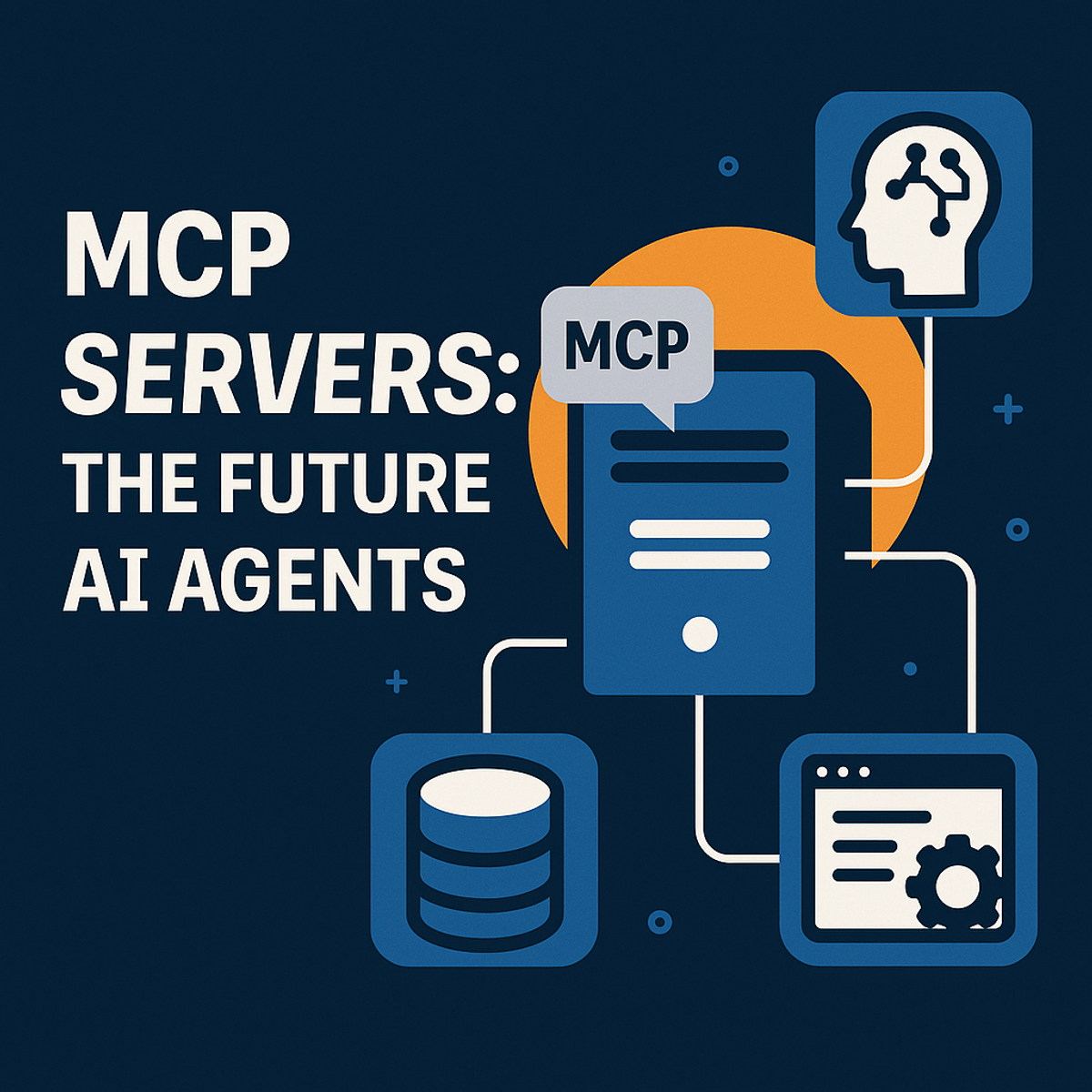
In simpler terms, an MCP server acts as a universal translator between AI agents and real-world tools — databases, CRMs, APIs, spreadsheets, analytics systems, and more.
Without MCP, each agent-to-tool connection must be built manually, leading to bloated, brittle code. MCP servers fix that by standardizing the interface — much like USB-C standardized device connections across hardware.
Think of it this way:
If AI models are the brains, MCP servers are the nervous system connecting those brains to the outside world.
⚙️ How MCP Servers Power the AI Agent Ecosystem
AI agents thrive when they can reason, act, and learn — and MCP makes all three easier.
1. Composable & Modular Agents
Instead of hard-coding each tool, MCP lets developers plug and play capabilities. A scheduling agent might call one MCP server for calendar data, another for CRM info, and a third for messaging — all without knowing how they work internally.
2. Security and Governance
MCP servers provide a natural layer for access control, logging, and identity management, preventing agents from overreaching into sensitive systems — a key advantage for regulated industries like healthcare and finance.
3. Interoperability
Because MCP is an open standard, any MCP-compliant agent can talk to any MCP-compliant tool. This creates the potential for a marketplace of reusable tools and agent modules, accelerating innovation across industries.
4. Persistent Memory and Context
MCP servers can host memory modules — allowing agents to recall previous interactions, preferences, and context. This makes future conversations more natural and personalized.
🌐 Why OpenAI’s Adoption Changes Everything
When OpenAI announced its integration of MCP into its Agents SDK and Apps SDK, the market took notice.
MCP now underpins how ChatGPT-powered agents can securely access external data and take action — through standardized “tools” exposed by MCP servers.
OpenAI Developers: MCP Server Overview →
OpenAI’s move signals that MCP isn’t just an experiment — it’s becoming the foundation of next-generation AI apps.
That endorsement has already led major developers and infrastructure providers to start building MCP-compatible APIs and connectors.
As one a16z analysis put it:
“MCP is the API layer for the agentic era — the bridge between models and the real world.”
🧠 Real-World Examples of MCP in Action
1. Healthcare Automation
Agents can securely access electronic health records via an MCP server that enforces HIPAA compliance — something we’re actively exploring for healthcare clients at Drive Phase Consulting.
2. AI Scheduling Assistants
Our AI scheduling agents leverage backend systems similar to MCP servers to manage appointment booking, rescheduling, and cancellations across SMS, phone, and chat — all integrated with Xano and GoHighLevel.
3. Enterprise Data Dashboards
A corporate agent could use MCP to pull metrics from Salesforce, NetSuite, and internal databases — creating unified analytics without manual integration overhead.
See our enterprise integration solutions →
🌊 Why MCP Represents the Wave of the Future
Here’s why this shift is bigger than it looks:
- Open Standards Win: Just as HTTP became the universal web protocol, MCP is emerging as the universal interface for AI tools.
- Composability Unlocks Scale: Businesses can mix, match, and upgrade agent capabilities without rewriting code.
- Security by Design: MCP servers create controlled “gateways” between AI and enterprise systems.
- Vendor Neutrality: As long as a system speaks MCP, it can interact with any agent — no lock-in.
The result is a future where AI systems behave more like ecosystems than products — composable, dynamic, and ever-evolving.
⚠️ Challenges to Watch
As with any new technology, MCP adoption comes with considerations:
- Security Risks: Malicious or misconfigured MCP servers could expose sensitive data.
- Latency: Tool calls introduce new network hops; optimization and caching are essential.
- Governance: Enterprises will need standards for auditing and access management.
- Maturity Curve: Developer tooling and directories for MCP servers are still emerging.
Despite these hurdles, the direction is clear — the industry is converging on MCP as the connective layer of the AI stack.
💡 What This Means for Businesses
For forward-thinking organizations, the rise of MCP represents massive opportunity:
- Build custom AI agents that plug directly into your existing tools.
- Adopt a modular approach to AI automation instead of costly monolithic systems.
- Future-proof your tech stack by aligning with OpenAI and Anthropic standards.
- Accelerate development using no-code tools that integrate with MCP backends — an area where Drive Phase Consulting excels.
Whether you’re building an internal workflow agent, an AI-powered customer assistant, or an enterprise dashboard — MCP will likely be the architecture underneath.
🧩 How Drive Phase Is Preparing for the MCP Era
At Drive Phase, we’re already building solutions that mirror the MCP approach — modular, secure, and scalable AI infrastructures.
Our team uses platforms like Xano, WeWeb, and Retell to create custom AI agents that integrate with enterprise systems, leveraging the same architectural principles MCP is built on.
We believe MCP servers will do for AI agents what APIs did for web apps — unlock an entirely new era of connected intelligence.
🔗 Further Reading
- OpenAI: Connectors and MCP Servers
- Anthropic: The Model Context Protocol Whitepaper
- a16z: A Deep Dive Into MCP and the Future of AI Tooling
- Drive Phase Consulting: AI Scheduling Agent Demo
- Drive Phase Consulting: Healthcare Integrations
🧭 Final Thoughts
The AI revolution isn’t just about smarter models — it’s about smarter connections. MCP servers represent the framework that will make AI systems more collaborative, secure, and extensible than ever before.
At Drive Phase Consulting, we’re helping companies navigate this new landscape — combining AI, automation, and no-code to bring ideas to life faster and at a fraction of the traditional cost.
If you’d like to explore how MCP-style architecture can accelerate your next project, get in touch with us.
Growth Engine Score
Find out where your business is losing momentum
Answer 11 questions, get your site measured live, and see your score in under 10 minutes — free.
Get Your Growth Engine Score →